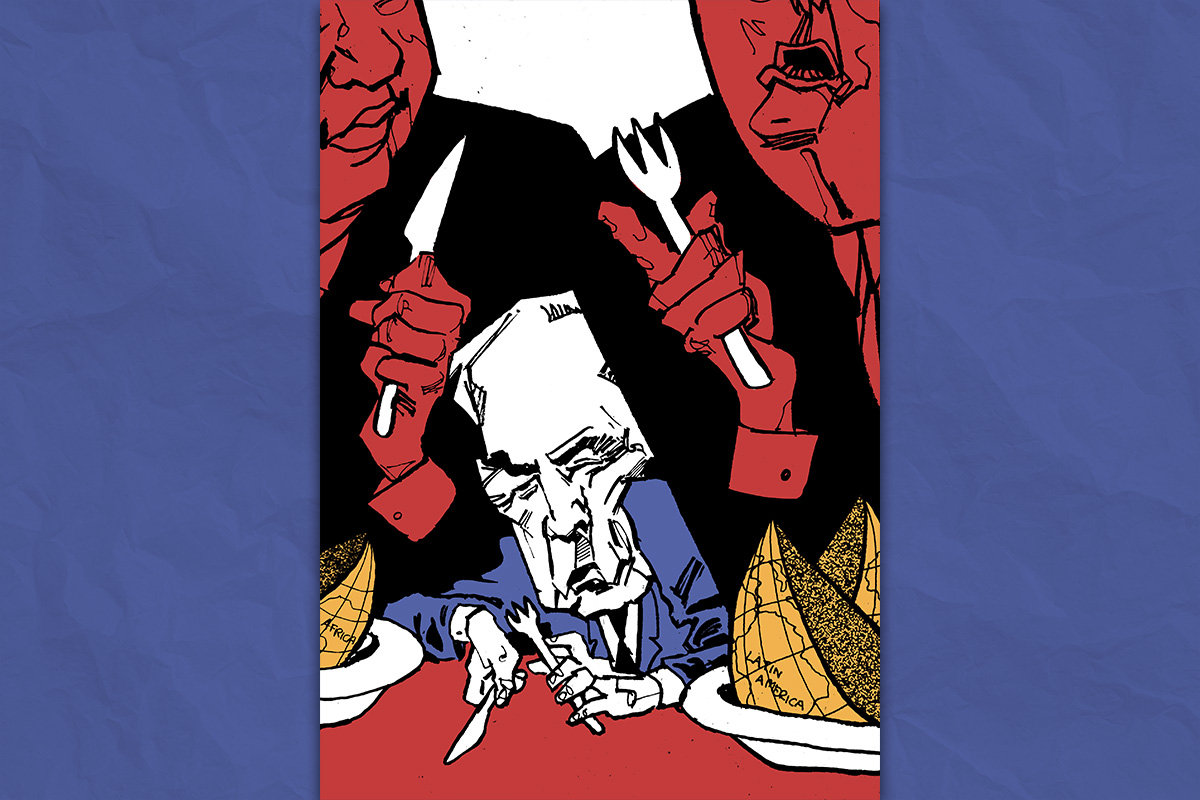
In a world of intensifying great power competition, Canadian Prime Minister Mark Carney has made waves by advocating for an alliance of “middle powers”. Recently, this has taken a more concrete form with talk of Canada becoming an ‘associate member’ of the European Union.
This alliance, Carney has argued, would be able to “build a new order that embodies our values, like respect for human rights, sustainable development, solidarity, sovereignty and territorial integrity of states.”
These proposals enjoy massive support within Canada, and have been praised by liberal politicians and their papers the world over. But this is ultimately a utopian fantasy. There is no ‘third way’ for the so-called middle powers in a world being torn asunder by imperialist conflict.
‘Middle powers’ and the struggle for the redivision of the world
In his book, Imperialism, the Highest Stage of Capitalism, Lenin explained that imperialism is not a policy choice or a “bad decision” made by short-sighted leaders; it is an inevitable stage in the development of the capitalist system.
Instead of the “free market”, we have giant industrial monopolies, dominated by huge banks. These giant cartels battle it out with each other for markets, sources of cheap labour, resources, etc. The politics of the imperialist nations inevitably flow from this as they divide the world among themselves in the interests of their national gang of capitalists.
When the balance of power shifts, imperialist powers are forced into a fierce struggle to redivide the world because the existing spheres of influence no longer align with their respective economic strength. As Lenin explained: “they divide it ‘in proportion to capital,’ ‘in proportion to strength,’ because there cannot be any other method of division under commodity production and capitalism.”
This is what we are seeing today. As Carney explained in an article for The Economist, “power no longer exclusively sits at a single western centre.” With China rising as an economic powerhouse and Russia asserting itself militarily, America’s unipolar dominance is finished. The old division of the world has become impossible to maintain, and a redivision is taking place on every continent.
This situation is especially bad for America’s former partners who have their own interests around the world. For example, Canadian mining firms operate all over South America, Africa, the Middle East and Asia. Canada was only able to achieve this position through the economic and military security umbrella guaranteed by U.S. imperialism.
As the old order breaks down—and as America becomes increasingly unreliable—the Canadian ruling class is scrambling to find a way to maintain their previous position. In the words of Carney, he wants Canada to be “at the table” so that they are not “on the menu.”
Illusion meets reality: ‘Values-based realism’
Carney first proposed the alliance of middle powers in his now-famous speech made at the World Economic Forum in Davos in January of this year. Lamenting the breakdown of the “rules-based order”, he criticised the post-WWII international system as “partially false,” noting that “trade rules were enforced asymmetrically” and “international law applied with varying rigour depending on the identity of the accused or the victim.”
Framing the geopolitical breakdown as an opportunity, he called for a coalition of middle powers that would “act consistently” and apply “the same standards to allies and rivals.” Yet Carney’s own actions have immediately exposed the hollow nature of these claims.
When the United States kidnapped Venezuelan President Nicolas Maduro in one of the most flagrant violations of national sovereignty, Carney produced a statement which stated that the Canadian government “welcomes the opportunity for freedom, democracy, peace, and prosperity.” Carney then supported the actions of the U.S. and Israel in their war against Iran and has remained silent as Trump has attempted to suffocate Cuba. European leaders have conducted themselves in a similar, cowardly fashion.
Equally hypocritical has been Carney’s rapid signing of trade deals with Saudi Arabia, Qatar and the United Arab Emirates, who are all notorious for their abysmal human rights records. Responding to criticism while he was in Jeddah, Carney stated: “lecturing countries from afar is an ineffective strategy.” According to Carney, this is what is known as “values-based realism”, which, as far as anyone can tell, just means abandoning principle for economic expediency.
This hypocrisy flows from the fact that Canadian businesses are overwhelmingly dependent on the American market. Approximately 75 per cent of Canadian exports are sold in the U.S. This dependence cannot be replaced by Europe—not least because, among the 27 European nations, ten have still not ratified the Canada-European Union Comprehensive Economic and Trade Agreement (CETA), even though it was signed in 2016.
Unsurprisingly, Trump said that he may consider Canada moving closer to Europe a “hostile act” and implement “very serious tariffs, or stop trading with Europe.”
Carney says that middle powers should “live the truth” and act together. But as a representative of the Canadian capitalist class, he must defend their interests. This means doing everything in his power to not anger their largest trading partner to the south, the truth be damned.
Jumping on a sinking ship
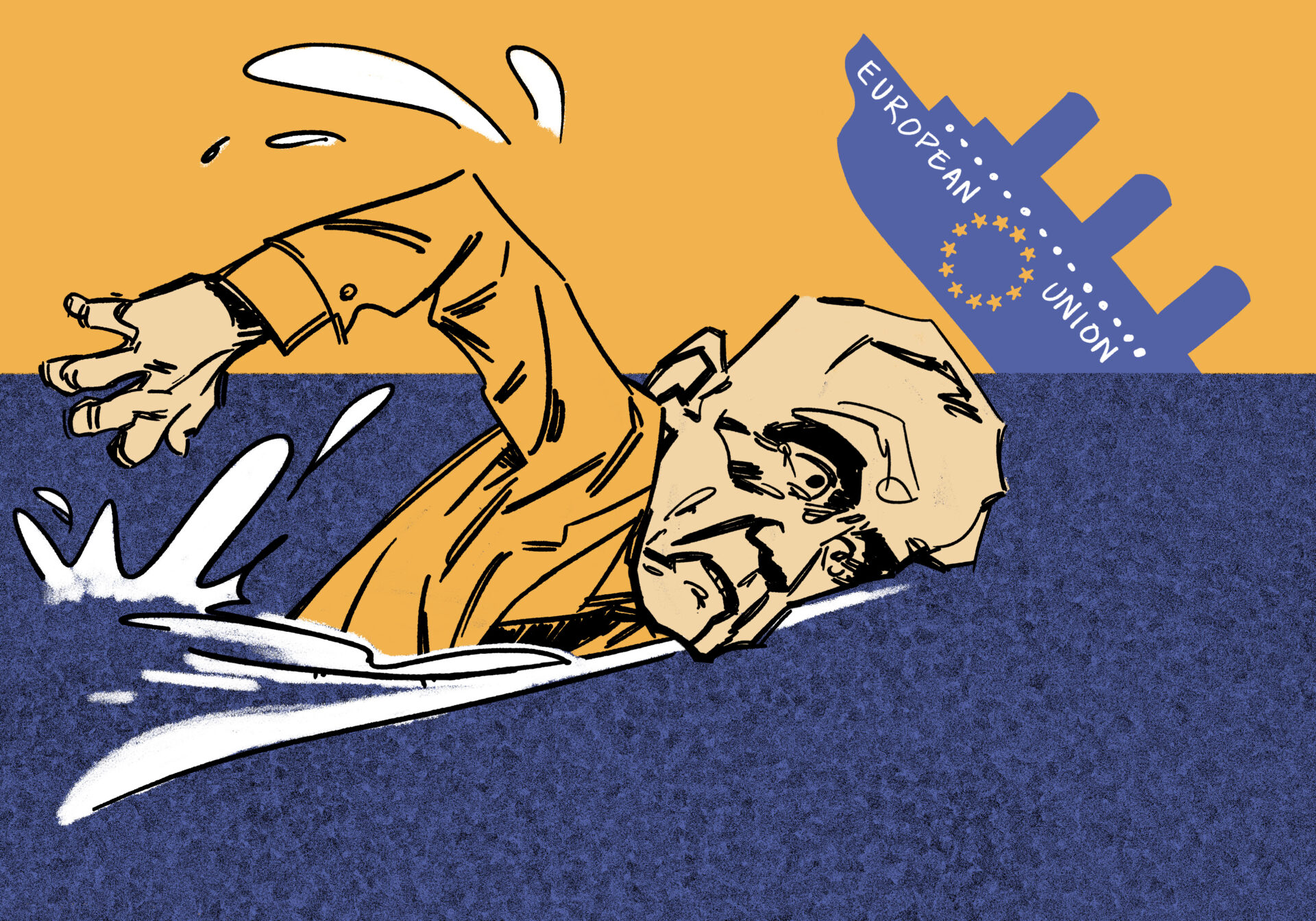
Carney’s proposal to align Canada more closely with the European Union is particularly ironic because the EU is the ultimate laboratory test—and failure—of a bloc of middle powers.
Under conditions of boom—under the aegis of American imperialism—the EU reached its peak at 29 per cent of world GDP. The 27 different member states achieved a remarkable degree of integration, going so far as to adopt a single currency.
But the unique conditions for this success have ceased. Under conditions of crisis, with their protector turning on them, the EU is plagued with internal contradictions. Faced with increasing pressure from all sides, the combined GDP of the EU has fallen to just 16.7 per cent.
The declining powers of Europe now find themselves caught between the rising economic might of China and the declining American empire, who are engaged in a struggle for control of the global economy.
The United States, which in the past acted as Europe’s protector and benefactor, is now treating it as a deadweight, or worse, a rival. By withdrawing from the continent, it has forced the Europeans to suddenly try to rearm to defend their imperialist interests. Economically, it forced Europe off cheap Russian gas onto expensive U.S. liquefied natural gas (LNG) and imposed an unequal trade deal on the EU, dramatically worsening Europe’s economic problems.
On the other side, the stagnating, fragmented industries of Europe have been eclipsed by Chinese production. The EU’s trade deficit with China has hit $1 billion per day. According to Alexander Julius, president of Eurometal, the trade organization representing buyers of steel products, “the Chinese are destroying the industrial backbone of Europe” due to increased imports of Chinese EVs and steel.
This decline is no secret even to European rulers. The landmark report on European competitiveness by former European Central Bank President Mario Draghi explicitly warned that Europe faces an “existential crisis.”
Highlighting an annual investment shortfall of €800 billion, crippling energy prices, and a fractured regulatory framework, the Draghi Report confirms that the European model is straining under the pressure of increased global competition. Similar to Carney, he urged the Europeans to combine economically and militarily in order to unleash their potential as the second-largest economy on the planet.
But faced with this desperate situation, they are failing on every level.
The problem resides in the fact that the EU is not a nation but a trading bloc of 27 countries, each with their own ruling classes, with their own separate interests. Now that the unique circumstances that enabled their integration have disappeared, their individual, national interests are asserting themselves, and the bloc is unravelling.
It is not united when facing these external threats. For example, the decision to impose tariffs against Chinese EVs saw ten member states vote in favour, five against, and 12 abstentions. While countries like France who have an auto industry feel threatened by Chinese EVs, weaker nations like Spain have been seduced by the investments offered by Chinese EV companies who are now opening up factories there in order to gain access to the European market.
The fact that the EU is an amalgamation of 27 smaller powers—with 27 governments, 27 armies, 27 capital markets, etc.—is undermining their cooperation. Economically, this has acted as a barrier to the accumulation of capital. European politicians are aware of the problem: European Commission President Ursula von der Leyen stated that the EU can “better compete globally with larger balance sheets.” But as European competition chief Teresa Ribera explained, “We cannot expect global champions to emerge from 27 fragmented markets.”
Similarly, this summer, the Future Combat Air System, a common European fighter jet program, collapsed because the French and German capitalists involved could not agree on revenue sharing, control, or the handling of sensitive intellectual property.
Draghi talked about the need to merge companies and banks into continental champions. But that would benefit some countries’ capitalists at the expense of others. Instead, European governments have intervened to protect their corporations and banks from takeovers by other European capitalists.
The latest example is the German government blocking Italian UniCredit from taking over the German Commerzbank. As a result, the largest U.S. bank now boasts a greater market capitalisation than the top ten European banks combined—even though the EU’s total GDP ($23 trillion) approaches that of the United States ($32.5 trillion).
If the European Union—with its integrated markets, common currency, and decades of legislative alignment—cannot overcome their petty internal squabbles to resist the great powers, adding Canada to the mix, or producing some other variant of a middle power alliance, is equally doomed to failure.
The great power conflict and the struggle for socialism
We face a renewed struggle for the redivision of the world. As the great powers clash, the small powers find themselves tossed this way and that, in one moment trying to placate the decaying hegemon, in the other, the rising dynamo.
Carney’s proposal for a bloc of middle powers represents a snake-oil solution peddled by the leader of a weak, declining small power which desperately is trying to maintain its old privileged position. All of the talk about “sovereignty”, “solidarity”, and “sustainable development” represents a lot of ideological hot air, spewed out to fool his voter base who hope for a return to better days.
There is no “third way” for the smaller powers, faced with a struggle between the great powers. As Europe demonstrates, in conditions of economic decline, the ruling classes are even more incapable of overcoming the limits of the nation state. Their enormous relative economic weakness leaves them little alternative but to obey the real powers, on which they are dependent. Carney is right—under imperialism “the strong can do what they can, and the weak suffer what they must.”
In the past, middle powers like Canada and the Europeans enjoyed the semblance of independence. But under conditions of crisis, that pretence has collapsed and these weak so-called middle powers are being reduced to a subordinate, third-rate status, deprived of the privileges they enjoyed in the past, disciplined as vassals and powerless to resist.
For Canada, this inevitably means being forced into some form of concessionary deal with America. For the European Union, it means fragmentation, pulled apart between Russia, China and America.
An epoch of renewed imperialist great power struggle means that wars and conflict will increasingly be resorted to. Matters cannot be settled any other way. Already, the prospective leaders of a future alliance of middle powers have shown that they are not trying to abolish imperialism, but trying to find a way to continue to benefit from its spoils.
We can have no faith in liberal politicians like Carney. The only force that can truly put an end to imperialism, and usher in an era of “genuine cooperation”, is the working class of the world.
Workers in every country, from Canada to America, from Europe to China, have an interest in overthrowing their ruling classes, putting an end to their petty squabbles. In a socialist world, we could unite the productive potential of the whole economy, putting an end to wars, poverty, inequality and all of the evils capitalism has visited upon us.

