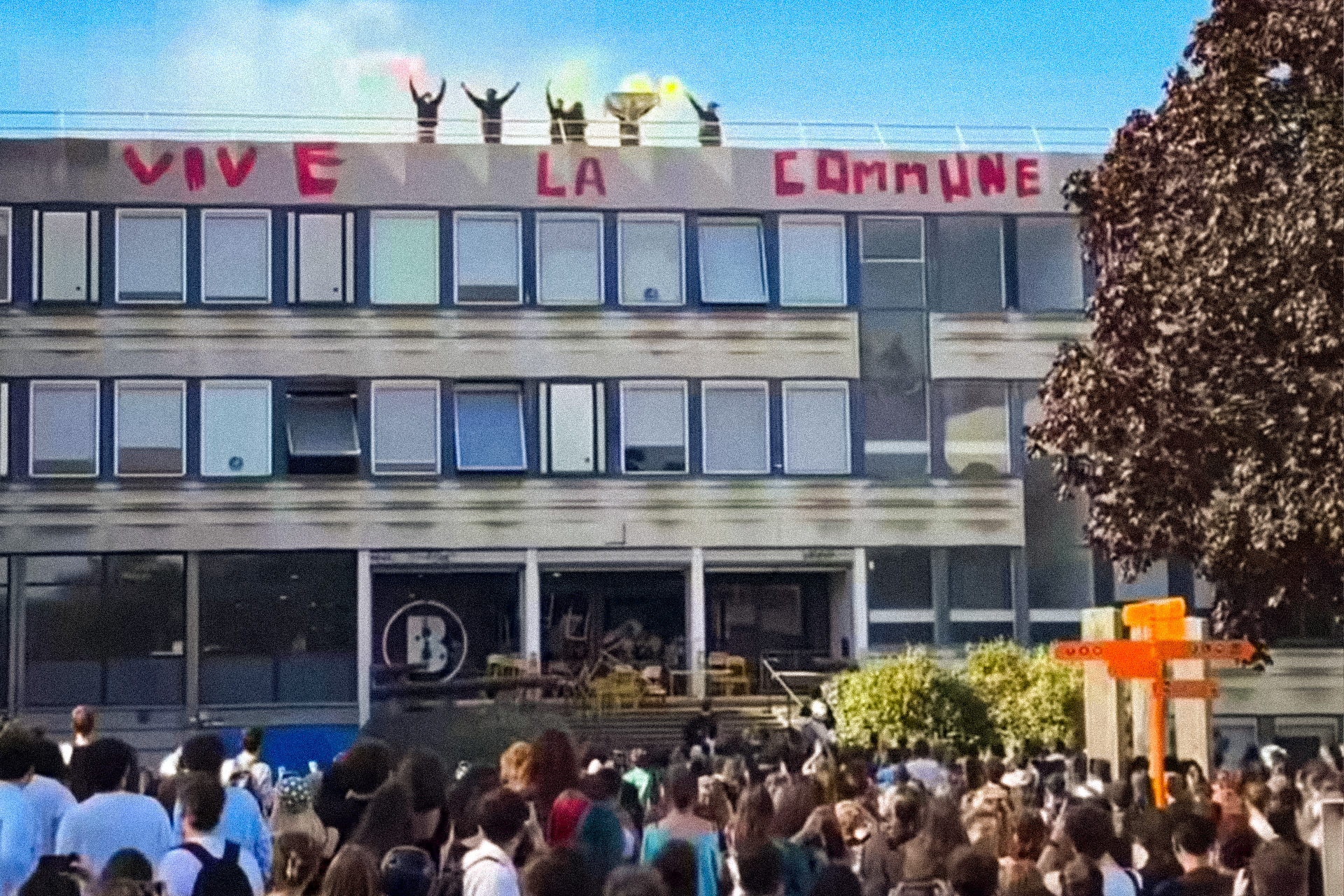
Oct. 6—the third act of the school students’ protests that have rocked France since the beginning of the school year—represented yet another escalation of the movement. The demonstrations were huge everywhere. According to the organizers, school and university student organizations, 100,000 marched in Paris alone, and a total of 450,000 marched across the country.
The demonstrations were lively, extremely youthful, and mainly composed of high school students, who turned up in quick-moving columns from each school and neighbourhood, armed with hundreds of home-made cardboard placards.
On Oct. 5, 2,000 high schools—over half the total—across the country were already blockaded. On Oct. 6, about 90 per cent of the country’s universities also joined the movement, following mass general assemblies attended by hundreds, and even thousands, of students.
Brutal repression
From the beginning, this movement has been met with brutal police repression. Since the movement began on Sept. 28, around 6,500 people have been arrested or stopped by the police. About 1,800 are facing prosecution—overwhelmingly minors.
Images of police brutality have circulated widely, further stoking the mood of anger and provoking widespread sympathy and revulsion. Yesterday, a 15-year-old in Lens had their hand blown off by a concussion fragmentation police grenade. Cops claim that he picked it up from the floor, but eyewitnesses maintain that the grenade hit him directly.
At the end of a mass demo in Rennes, riot police brutally kicked a young female high school student. In Noisy-le-Grand, a teenager was attacked by riot police on the steps of his high school, after tear gas was used directly on his face. As a result, he started convulsing and lost consciousness. He was dragged down the stairs by two riot cops and eventually had to be taken away in an ambulance. One high schooler has lost an eye. Another lost several teeth from the direct impact of a police grenade.
Riot police have not spared any means at their disposal in dealing with teenage protesters. Concussion grenades, tear gas, horseback charges; in Paris, they used shields featuring a strobe dazzling device! At the Sorbonne Nouvelle University, riot police entered the premises to shut down a general assembly of hundreds of students and staff.
Generational revolt
Rather than cowing the movement as was the intention, repression has further enraged the youth and brought them widespread solidarity. An opinion poll last week showed 62 per cent of the population say the school student movement was justified.
Over the last few days, trade union militants across the country have mobilized to provide protective stewarding for the movement, and have physically defended high school students from police attacks.
While there wasn’t a generalized strike movement on Oct. 6, there was a significant degree of participation by trade union militants in the demonstrations. There were delegations from key workplaces, as well as a widespread strike movement among high school teachers.
What started as a movement which brought together several sources of anger (teacher shortages, poor facilities, lack of budget, long hours of study, the opaque university access system, etc.) has now become a full-blown generational revolt.
The Gen Z revolution has firmly arrived in France. School students have been seen carrying placards proclaiming “generation 6-7 doing May ‘68 all over again.” At Rennes 2 University, students on strike have painted the slogan “Vive la Commune”—a reference to the Paris Commune—on one of the main buildings.
A key factor in this movement is the rejection of the far-right National Rally (RN) of Le Pen and Bardella and their racist and xenophobic politics. The slogan “la jeunesse emmerde le RN” (“the youth says: fuck the RN”) has been revived. This slogan is felt strongly, as the movement started in the more dilapidated high schools in the banlieues, the impoverished working-class suburbs, where a large percentage of school students are Arab and black.
Also significant and notable is that a large number of young women are participating in the movement and have played a leading role in the demonstrations and lycée blockades.
Enormous pressure
As with every mass movement in France, Le Pen’s RN has been caught off guard. Though they pose as anti-establishment, they now find themselves on the same side as the government in opposition to a very popular movement.
Meanwhile, Mélenchon’s La France Insoumise (LFI) has thrown itself into supporting the movement, and instructed all of its elected representatives to go down to the high schools and help defend the students from police repression. The LFI mayor of Saint-Denis, Bally Bagayoko, has become a very popular figure in the movement.
Lecornu’s highly unpopular government is increasingly coming under pressure. Repression has failed to crush the movement, and now the government fears that it will converge with the general movement of the working class. Several sectors are either currently on strike or have strikes planned, including civil servants, health workers, and workers in the energy and chemical sectors. There have also been calls for a new yellow vests movement on Oct. 17.
For now, the minister of education has decided to suspend all academic activity in high schools across the country until Monday. Instead, he has called for a “democratic pause” in which school students reopen the blockaded schools to go back in and “discuss their grievances”.
But the school students have replied by saying that they already know what their grievances are: they are demanding action on them, and they will not unblock the lycées. The high school and university student organizations have called for another national day of action on Thursday, Oct. 8.
Macron convened an emergency crisis meeting at the end of the day on Oct. 6, which included the prime minister, the minister of the interior and the minister of education. The prime minister will address the country on Wednesday, Oct. 7. The minister of the interior has banned the police from using concussion grenades.
The government and Macron himself are caught in a dilemma. Repression has only inflamed the movement further, but there is very little room for concessions, as the school students’ demands are mainly over budgetary questions.
Crisis of French capitalism
The school student movement, which may spread to become a full-blown social uprising involving the organized working class, is a manifestation of the deep crisis of French capitalism.
In essence, the crisis of capitalism means the ruling class demands deep cuts in social spending. Debt is now 119 per cent of GDP and the annual cost of debt servicing—which currently sits at €70bn or three per cent of GDP—is projected to rise to over €90bn by next year. This figure far exceeds the national budgets for education (€65 billion) and even defence (€63 billion). The budget deficit is 5.4 per cent of GDP.
Carrying out even a fraction of the cuts demanded by the ruling class will make any government deeply unpopular—hence why there has been a rapid collapse of the centre and all of the establishment parties. As such, anti-establishment formations are on the ascent, both on the right with the RN, and on the left with LFI.
Interestingly, Le Pen’s RN held a press conference to explain its economic program. At the conference, they presented themselves as the party of fiscal responsibility, promising to bring down the deficit and to introduce a “constitutional golden rule to legally cap future deficits.” They committed to bring down the deficit to below three per cent of GDP by 2030 through a program of “savings” worth €140 billion.
As they come closer to power, reactionary demagogues feel the need to reassure the capitalists that they will be a safe pair of hands. In order to please their electorate, however, they pledge to carry out these austerity measures without cutting education or pensions, something which is obviously not possible.
Meanwhile, if the Lecornu government (seeing that repression has backfired) makes concessions to the school students, then “the markets” (that is, the capitalist investors purchasing bonds) will punish it. They would consider the government as not serious about bringing down the deficit. But if the government does not make concessions, the movement may spread, widen and become an unstoppable force which will brush the government to one side.
The Financial Times carried an alarmist article under the headline “France between the bond market and the barricades”, which made the point that:
“France is caught between the protesters on the street calling for more funds from the government and ‘bond vigilantes’ in the markets who punish perceived fiscal irresponsibility by betting against the country’s debt.
“Tensions are rising as the confrontation over the budget deepens and the country prepares for an April presidential election that could end in a face-off between the far right and hard left. The fear among investors is that the country could be tipped into a full-blown debt crisis that could not only rock France’s economy but also shake the Eurozone.”
The New York Times also sounded the alarm bell:
“‘France’s position looks unsustainable and the bond markets are saying that, but they’re not screaming it yet,’ said Kenneth Rogoff, a professor of economics at Harvard and a scholar of financial crises. ‘It’s a slow-motion train wreck.’”
The same paper quoted a political risk analyst, who described the situation in these terms:
“‘It’s not just a debt crisis or bond-market crisis,’ Mr. Rahman continued. ‘The investors I’m talking to are worrying about an existential political and constitutional crisis. It’s all of these issues coming together in a deeply unhelpful way for whoever wins the presidential election.’”
This situation is not unique to France. Similar conditions exist in major European economies like Italy, Spain, and Britain. The crisis of capitalism in Germany is also very deep, though the debt is not so exorbitant—for now.
Similar conditions tend to produce similar results. The whole of Europe is a powder keg, ready for a social explosion.

