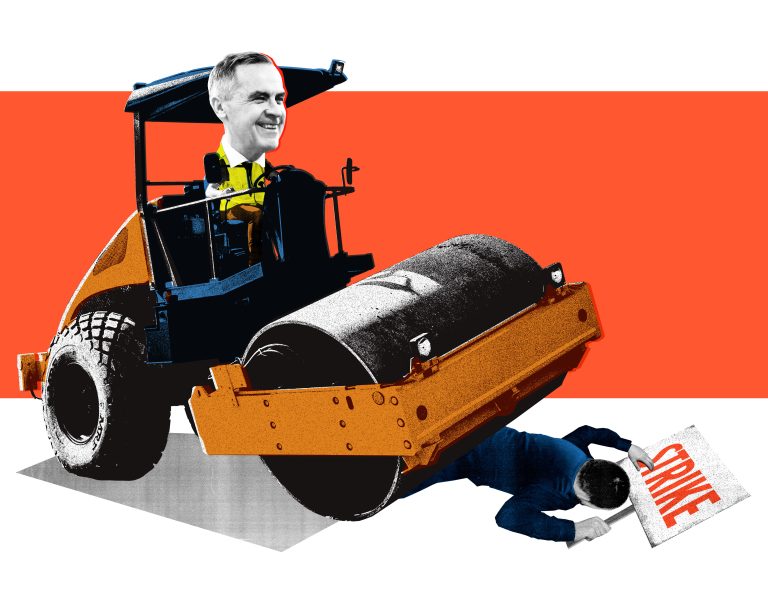
On Sept. 21, the Liberals introduced Bill C-39, a massive omnibus bill which contains sweeping changes to the Labour Code, including attacks on the right to strike.
The bill, titled the “Building Canada Strong Act,” was proposed by the Liberals as a way to speed up large infrastructure projects by cutting red tape. In reality, Carney wants to build “Canada strong” by breaking the strength of workers.
More of the same
This bill comes after months of “consultations” with capitalists and unions, in which the government proposed a series of changes to the Labour Code, centring around different ways to clamp down on strikes. Some of those plans have been abandoned in favour of a much simpler route.
Far from “absolutely reinforc[ing] the right to strike,” as Mark Carney claimed, this law would only reinforce the Liberals’ new preferred method of strike breaking: the use of section 107 of the Canada Labour Code.
Section 107 gives the Minister of Labour the power to do whatever they deem necessary to restore “labour peace” in federally regulated sectors, including rail, ports, airports and the postal service. The government started using this method in the recent past to refer numerous strikes to the Canadian Industrial Labour Board (CIRB), which has then sent the workers back to work and imposed binding arbitration. Between 2023 and 2025, the Liberals have relied on this method to shut down 10 different job actions.
The benefit of this method is clear. It allows the government to avoid passing back-to-work legislation, sidestepping parliamentary debate and the risk of MPs voting the legislation down.
Through the summer’s consultations, unions recommended the government remove section 107 entirely. Instead, it’s been fortified.
Supporters of the bill in government and in bosses’ boardrooms have argued that it is favorable to workers, because it creates a framework around the use of section 107, thereby putting restraints on the power of the Minister to end strikes. Notably, under the new revamped section 107, the Minister of Labour will have to appoint a “special mediator” who would then create a report. Only after a period of 21 days following this appointment can the Minister issue a back-to-work order. The criteria for this back-to-work order is whether or not the strike or lockout would have a “significant adverse national impact”—notably a “significant impact on the Canadian economy.”
In reality, this is no gift to the workers, but the codification of a power that was otherwise on shaky grounds. As mentioned, section 107 has only recently been used to issue back-to-work orders. Before that, it was a dusty section of the Labour Code, forgotten by lawyers until it was revived by the Liberals. Before the renovation by Bill C-39, its formulation was so vague and broad that it isn’t even clear if back-to-work orders were its intended purpose. This left it open to being challenged in the courts—as unions are currently doing.
Make no mistake, this new bill is not meant to limit the power of section 107 to break strikes, but to confirm it.
‘National interest’
The government has capitalized on the economic uncertainty caused by the trade war to attempt to push through these sweeping measures. They frame the bill as a way to “advance projects of national interest” by “reducing red tape” and moving to “modernise federal labour protections.”
What’s meant by this doublespeak is that Canadian capitalism needs investment and needs to attack any barriers to profit that are keeping investment out of Canada, including workers’ right to strike. As the Canadian Federation of Independent Business (CFIB) explained, “When we close our ports, stop our rail and air service and even cancel the mail for months, it doesn’t send the message that Canada is open for business.”
Liberal MP Corey Hogan explained to the CBC that these enhanced powers of the Labour Minister are “incredibly useful as signals to capital… this is part of us providing that durability and that regulatory assurance that [investors] are looking for.”
It’s exactly these interests, the interests of investors, that the government is referring to when they speak about the “national interest” in order to justify new strikebreaking laws. But with the frequency of strikes on the rise in recent years, some capitalists aren’t satisfied.
“I worry these changes may not be enough or that they may be simply ignored by unions who want to test the government’s resolve,” writes Dan Kelly for the CFIB. He also suggested that if Bill C-39 doesn’t sufficiently clamp down on strikes, the government should “consider expanding essential services legislation,” which would impose severe limits on certain sectors. The capitalists have the right to strike in their crosshairs, and this new bill is only the first shot.
‘Team Canada’ exposed
The response of union leaders across Canada has been one of utter bafflement and surprise. “Canada’s unions are part of Team Canada. We have our elbows up. But we can’t have our elbows up against Trump with our hands tied at the bargaining table,” wrote Bea Bruske, president of the Canadian Labour Congress, about the legislation.
“The Prime Minister has a mandate to defend Canada against Trump—not to run roughshod over our constitutional rights. Gutting Canadians’ Charter rights will not make us stronger against Trump—it will make us weaker,” said CUPE National President Mark Hancock.
Union leaders have spent the last year cozying up to the government, hopping on the “Team Canada” bandwagon and falling behind the Canadian capitalists. Their reasoning was that what’s good for business is what’s good for workers.
This bill shows the failure of this approach—and who the government is really working for.
In fact, it is the “Team Canada” approach that ties the hands of Canadian workers—to the Canadian bosses, that is. The farce of “Team Canada” has always been a way to get the workers to shut up and foot the bill for the bosses’ crisis.
This false unity must be broken in order for unions to defend workers’ rights.
How to fight back
Nonetheless, union leaderships have issued statements vowing to defy any order attacking the right to strike under the new bill. This is a welcome development, as unions have mostly neglected to defy the wave of back-to-work legislations and orders in the past period.
Now these words have to be backed up by actions. And the struggle cannot be limited to litigation, as some unions have hinted at. Legal challenges pull the struggle out of the hands of workers, and place it into the courts, which are rigged in favour of the bosses.
Instead, the most effective way to fight back against the government’s strikebreaking is with militant action—defying the orders as soon as they are given and preparing to escalate further. This is what allowed the Air Canada flight attendants to defeat a back-to-work order last year, when they defied the order and forced the government to back down.
But this attack isn’t just on one union or one strike—it’s a threat being levied against the 1.4 million workers regulated under the Labour Code, including railworkers, telecommunications, public services, broadcasting, ports, the postal service, and more. This is an attack on a country-wide scale which demands a nationally organized response. And if this bill is allowed to pass, provincial governments will see this as the signal to adopt their own anti-strike legislation, as has already been the case in Quebec.
To defend the right to strike, we’ll need a national defiance movement, including solidarity pickets and mass demonstrations. Such a strategy should encompass the entire labour movement, as part of a mass campaign against this undemocratic bill and ultimately for the reversal of section 107 and similar provincial legislation. Such a movement can and must be prepared now, beginning with the labour leaders pointing a clear way forward.
In order to do that, we have to tell the truth. Carney is on the side of the bosses. His government is preparing attack after attack on the working class. Workers have nothing to gain by siding with this ex-Goldman-Sachs banker. Only by uniting along class lines can workers fight back against these undemocratic laws and the capitalist system which demands them.

