Leon Trotsky once noted that revolution affects the nerves before it hits the streets. Before a revolution breaks out, anger bubbles up beneath the surface of society and influences people’s moods and thinking. This tends to reflect itself in the art that precedes great social explosions.
The works of French film director Jean-Luc Godard provide a view of this process in the lead-up to the revolution of May 1968.
France in the 1960s
France in the mid-1960s was a boiling cauldron. Workers strained under fifty-hour weeks and breakneck paces of work. The radicalization in society could be seen particularly clearly in the youngest generation of workers.
The youth were in ferment. A flashpoint had been the Indochina and the Algerian Wars—waged by the French ruling class to try to retain its colonies. When the youth protested, they were met with batons and tear gas.
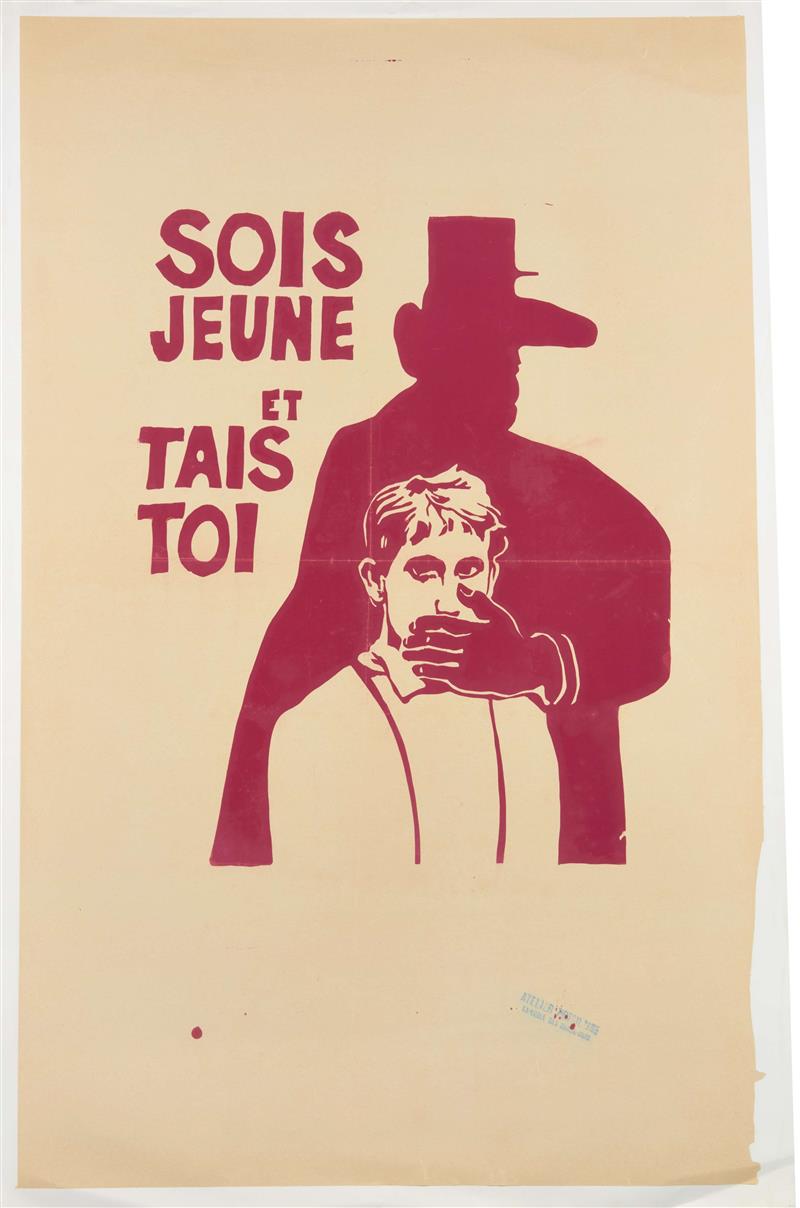
The youth felt that their appeals to the establishment would always fall on deaf ears. This sentiment would later be expressed in a popular ironic slogan during May ’68: “be young and shut up.” The youth started drawing conclusions about needing to change the system.
The radicalizing layers of young people could have been organized into a mass communist party. In fact, such a party already existed: the Communist Party of France (PCF). But the PCF, despite being a mass organization with leadership of the main trade union, had alienated the youth. Thoroughly Stalinized, it had long ago abandoned a revolutionary perspective. For example, the PCF scandalously opposed Algerian independence until 1958—and after this, only supported it tepidly.
To many young radicals, the PCF seemed like just another part of the French establishment. So they looked for a revolutionary way forward elsewhere. On the campuses, they formed themselves into a panoply of small communist and left-wing groups. These were no doubt sincere, but everywhere confusion reigned.
Jean-Luc Godard
The process of radicalization in the youth found its reflection in Jean-Luc Godard’s filmography.
He was radicalizing along with the youth, and in the mid-1960s he began to openly describe himself as a revolutionary and a Marxist. His films began to explicitly comment on capitalism and the growing revolutionary mood in society. But he was not interested in simply commenting on the state of things.
Godard spoke of “starting cinema from scratch” and of creating a “revolutionary cinema,” i.e. a cinema that would help along the process of revolution. Godard was confused about how to do this. It seems like many isolated radicals, he believed the working class were apolitical and needed to be shocked into action—an idea which can be seen in his pessimistic film Week-end.
In 1967, Godard released La Chinoise. His intention with the film was to make broader layers of the public understand the radicalization of the students. As he puts it: “I had the idea to make a film on the students, the only ones today with whom I feel some affinity. [La Chinoise] is about the politicization of the students and the de-politicization of the population.”
Of course, events would soon show that the population was far from de-politicized. But, released less than a year before May ’68, the film acts like a time capsule of the mood in the run-up to the revolution.
A portrait of the youth
La Chinoise depicts a group of five Maoist students, spending their days discussing revolutionary theory, planning party activity, and smoking copious amounts of cigarettes.
The film shows these youth discussing how to overthrow bourgeois society, groping for some kind of way forward. They conclude that this can only be done through bombings and assassinations.
Here, Godard pushes against the limits of what can be considered to be narrative film. The plot is extremely bare and the students function more as mouthpieces for particular points of view than as fleshed-out characters. Yet, these ideas are furled out and examined in a way that’s closer to poetry than a political treatise.
La Chinoise is really remarkable for its balanced, but ultimately sympathetic view of its subjects. These students, to put it plainly, are a bit silly. They’re completely isolated from the working class. They’re bohemians. And most of their views would be confusing even to those with a background in Marxism and philosophy.
But at the same time, they are completely sincere in their convictions. They are rightfully disgusted at the hypocrisies of bourgeois society. And they’re willing to take on extreme personal risk to put their ideas into practice.
In the film, their confusions are presented as not so much their own fault as the fault of the intellectuals and “official” left parties who failed to give them a lead. In one scene, the students are outraged by the inaction of Stalinist Russia towards the war in Vietnam. In another scene, the students complain that L’Humanité, the newspaper of the PCF, denounces them with the same language as the bourgeois press.
At one point, one student debates her terrorist ideas with a popular left academic of the time, who’s played by himself. He considers individual terrorism to be an insane tactic. His criticisms are largely correct. But he does nothing but condemn her. He suggests no alternative way forward and does nothing to convince her.
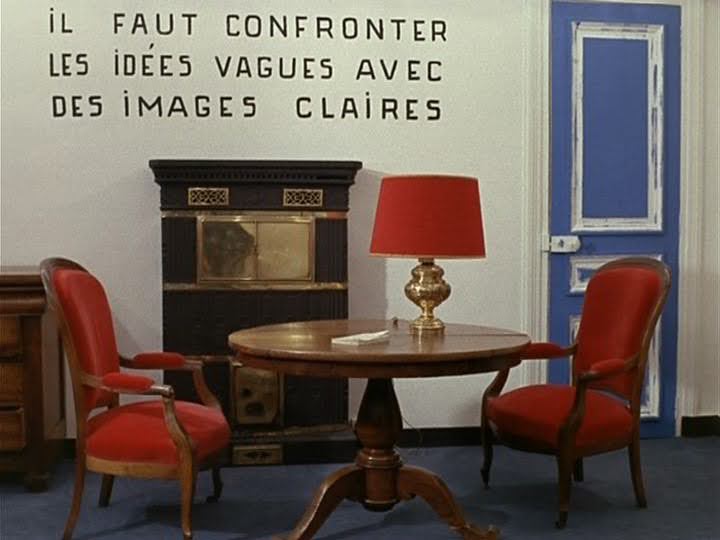
Despite showing these youth as confused, Godard shows that this is not for want of trying. At the same time, it seems Godard is directly addressing these youth, trying to challenge them to think more deeply about their ideas. In one of the first scenes, we see “we must confront vague ideas with clear images” written on the wall of the students’ apartment. Godard also uses a variety of techniques—like leaving the clapboard at the start of certain shots or revealing the cameraman in a scene—to remind his viewers that they are watching a film and should therefore critically think about what is being said.
The youth of today
La Chinoise is a challenging film. It is unclear whether Godard agrees with everything the characters say and do—and it is likely he himself did not know. To his credit, he does not pretend to tell the audience what he is not sure of himself. It is up to the audience to make up their own minds. What a contrast to today, with its avalanche of movies that treat their audiences like children!
Godard clearly sympathizes with the youth and their struggle to understand how to change the world. He presents an honest picture of their state of mind—a picture which not only allows us to understand the mood prior to May 68, but the mood of the youth of today.
The youth of today have seen nothing but crisis. They are tired of being told to “be young and shut up.” In France today, kids as young as twelve are in the streets in their masses, braving the full force of the police.
The youth must not be talked down to, nor treated like children. Large layers are drawing revolutionary, communist conclusions and are looking for clear ideas that will allow them to change the world. It is the job of the communists of today to give them the ideas that were lacking in 1968, the ideas we need to win.

